Monday, 6 March 2017

UGC-NET January 2017 Paper-2

    Q::1 Consider a sequence  defined as:


  •  
     for n ≥ 2
    Then what shall be the set of values of the sequence ?
    (1)   (1, 110, 1200)                                   (2)   (1, 110, 600, 1200) 
    (3)   (1, 2, 55, 110, 600, 1200)             (4)  (1, 55, 110, 600, 1200)

    Answer:: (1)

    Explanation:: http://cbsenetmaterial.blogspot.in/2017/03/ugc-net-january-2017-paper-2-solved.html

    1. Q::2  Match the following:

    List-I
    List-II
    1. (a) Absurd
    1. (i)Clearly impossible being contrary to some evident truth.
    1. (b)Ambiguous
    1. (ii)Capable of more than one interpretation or meaning.
    1. (c)Axiom
    1. (iii)An assertion that is accepted and used without a proof.
    1. (d)Conjecture
    1. (iv)An opinion preferably based on some experience or wisdoms.
    Codes:

    a
    b
    c
    d
    1. (1)
    i
    ii
    iii
    iv
    1. (2)
    i
    iii
    iv
    ii
    1. (3)
    ii
    iii
    iv
    i
    1. (4)
    ii
    i
    iii
    iv
    1. Q:: 3  The functions mapping R into R are defined as: f(x) =  and h(x) = .

    Then find the value of the following composite functions: hog(x) and hogof(x)

    (1)        and     
    (2)        and     
    (3)      and    
    (4)      and   

           Answer:: (4)


    1. Q:: 4 How many multiples of 6 are there between the following pairs of numbers? 0 and 100 – 6 and 34

    2. (1)16 and 6                                                       (2)  17 and 6 

    3. (3)  17 and 7                                                     (4)  16 and 7

          Answer:: (1)


    Q:: 5 Consider a Hamiltonian Graph G with no loops or parallel edges and with 
    |V(G)| = n ≥ 3. Then which of the following is true?

    (1)deg(v) ≥ n/2 for each vertex v. 

    (2) |E(G)|>=1/2(n-1)(n-2) + 2

    (3)deg(v) + deg(w) ≥ n whenever v and w are not connected by an edge.

    (4)All of the above


    Q:: 6 In propositional logic if (P → Q) ∧ (R → S) and (P ∨ R) are two premises such that

    (P → Q) ∧ (R → S)
    (P ∨ R)


    Y is the premise:

    (1)P ∨ R                                            (2)  P ∨ S   

    (3)  Q ∨ R                                          (4)   Q ∨ S

    Q:: 7 ECL is the fastest of all logic families. High speed in ECL is possible because transistors are used in difference amplifier configuration, in which they are never driven into ________.

    (1)Race condition                        (2)  Saturation 

    (3)  Delay                                         (4)  High impedance


    Q:: 8. A binary 3-bit down counter uses J-K flip-flops, FFi with inputs Ji, Ki and outputs Qi, i=0,1,2 respectively. The minimized expression for the input from following is

    I. J0=K0=0

    II. J0=K0=1

    III. J1=K1=Q0

    IV. J1=K1=Q’0

    V. J2=K2=Q1Q0

    Vl. J2=K2=Q’1Q’0


    (1) I, Ill, V                                                                    (2) I, IV, VI 


    (3) Il, III, V                                                                  (4) Il, IV, Vl

    Answer:: (4)

    Q:: 9 Convert the octal number 0.4051 into its equivalent decimal number.

    (1)0.5100098                                               (2) 0.2096 

    (3) 0.52                                                           (4) 0.4192
    1.  

    Q:: 10 The hexadecimal equivalent of the octal number 2357 is:

    (1)2EE                                                            (2) 2FF 

    (3) 4EF                                                           (4) 4FE
    1.  
    2. Q:: 11 Which of the following cannot be passed to a function in C++?

    3. (1)Constant                                                  (2) Structure 

    4. (3) Array                                                        (4) Header file

    1. Q:: 12 Which one of the following is correct for overloaded functions in C++? 

    2. (1)Complier sets up a separate function for every definition of function.

    3. (2)Complier does not set up a separate function for every definition of 
    4. function.

    5. (3)Overloaded functions cannot handle different types of objects.

    6. (4)Overloaded functions cannot have same number of arguments.

    1. Q:: 13 Which of the following storage classes have global visibility in C/C++?

    2. (1)Auto                                                                (2) Extern 

    3. (3) Static                                                             (4) Register

    1. Q:: 14 Which of the following operators cannot be overloaded in C/C++?

    2. (1)Bitwise right shift assignment

    3. (2)Address of

    4. (3)Indirection

    5. (4)Structure reference

    1. Q:: 15 If X is a binary number which is power of 2 , then the value of X  & (X – 1) is:

    2. (1)11….11                                                         (2) 00….00 

    3. (3) 100….0                                                        (4) 000….1

    1. Q:: 16 An attribute A of datatype varchar (20) has value ‘Ram’ and the attribute B of datatype char (20) has value ‘Sita’ in oracle. The attribute A has ____memory spaces and B has _____     memory spaces.

    2. (1)20,20                                                            (2) 3,20 

    3. (3) 3,4                                                                (4) 20,4

    1. Q:: 17 Integrity constraints ensure that changes made to the database by authorized users do not result into loss of data consistency .
    2. Which of the following statement(s) is (are) true w.r.t. the examples of integrity constraints?

    3. (A)An instruction Id. No. cannot be null, provided Intructor Id No. being primary key.
    4. (B)No two citizens have same Adhar-Id.
    5. (C)Budget of a company must be zero. 

    6. (1)(A), (B) and (C) are true.                                (2)(A) false, (B) and (C) are true. 

    7. (3)(A) and (B) are true; (C) false.                     (4)(A), (B) and (C) are false.

    1. Q:: 18 Let M and N be two entities in an E-R diagram with simple single value attributes. and are two relationship between M and N, where as  is one-to-many and is many-to-many. The minimum number of tables required to represent M, N, and in the relational modal are _____.  

    2. (1)4                                                                                (2) 6 

    3. (3) 7                                                                               (4) 3  

    1. Q:: 19 Consider a schema R(MNPQ) and functional dependencies M → N, P → Q. Then the decomposition of R into into (MN) and  is ____.

    2. (1)Dependency preserving but not lossless join.

    3. (2)Dependency preserving and lossless join.

    4. (3)Lossless join but not dependency preserving

    5. (4)Neither dependency preserving nor lossless join.

    1. Q:: 20 The order of a leaf node in a  true is the maximum number of children it can have. Suppose that block size is 1 kilobytes, the child pointer takes 7 bytes long and search field value takes 14 bytes long. The order of the leaf node is ______.

    2. (1)16                                                                                   (2) 63 

    3. (3) 64                                                                                  (4) 65

    1. Q:: 21 Which of the following is true for computation time in insertion, deletion and finding maximum and minimum element in a sorted array?

    2. (1)Insertion – 0(1), Deletion – 0(1), Maximum – 0(1), Minimum – 0(1)

    3. (2)Insertion – 0(1), Deletion – 0(1), Maximum – 0(n), Minimum – 0(n)

    4. (3)Insertion – 0(n), Deletion – 0(n), Maximum – 0(1), Minimum – 0(1)

    5. (4)Insertion – 0(n), Deletion – 0(n), Maximum – 0(n), Minimum – 0(n)

    1. Q:: 22 The seven elements A,B,C,D,E,F and G are pushed onto a stack in reverse order , i.e., starting from G. The stack is popped five times and each element is inserted into a queue. Two elements are deleted from the queue and pushed back onto the stack. Now; one element is popped from the stack. The popped item is _____.
    2. (1)A                                                                                   (2) B 

    3. (3) F                                                                                   (4) G

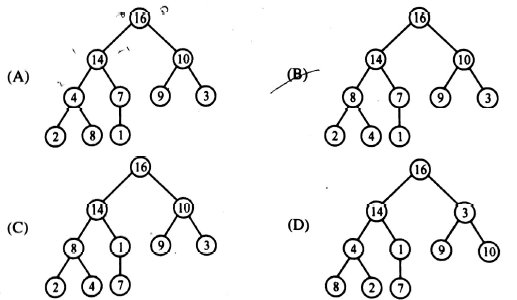
    1. Q:: 23 Which of the following is a valid heap?
    1.  
    2. Q:: 24 If h is chosen from a universal collection of hash functions and is used to hash n keys into a table of size m. where n ≤ m, the expected number of collisions involving a particular key x is less than _____.
    3. (1)1                                                                              (2)  
    4. (3)                                                                            (4) 

    1. Q:: 25 Which of the following statements is false?

    2. (A)Optimal binary search tree construction can be performed efficiently using dynamic programming.

    3. (B)Breadth-first search cannot be used to find connected components of a graph.

    4. (C)Given the prefix and postfix walks of binary tree, the cannot be re-constructed uniquely.

    5. (D)Depth-first-search can be used to find the connected components of graph

    6. (1)A                                                                                  (2) B 

    7. (3) C                                                                                 (4) D


    1. Q::26 Match the following Layers and Protocols for a user browsing with SSL:
    1. Application of layer        i.        TCP
    2. Transport layer                ii.        IP
    3. Network layer                iii.        PPP
    4. Datalink layer                iv.        HTTP
    Codes:

            a        b        c        d
    (1)iv        i        ii        iii
    (2)iii        ii        i        iv
    (3)ii        iii        iv        i
    (4)iii        i        iv        ii


      Q:: 27 The maximum size of the data that the application layer can pass on to the TCP layer below is _______.


      (1)                                                     (2) bytes + TCP header length


      (3) bytes – TCP header length                    (4) bytes

    1. Q:: 28 A packet whose destination is outside the local TCP/IP network segment is sent to _____.

    2. (1)File server                                                         (2)DNS server

    3. (3)DHCP server                                                     (4)Default gateway

    1. Q:: 29 Distance vector routing algorithm is a dynamic routing algorithm. The routing tables in distance vector routing algorithm are updated ______.

    2. (1)Automatically

    3. (2)By server

    4. (3)By exchanging information with neighbor nodes

    5. (4)With back up database

    1. Q:: 30 In link state routing algorithm after , construction of link state packets, new routes are computed using:

    2. (1)DES algorithm

    3. (2)Dijkstra’s algorithm

    4. (3)RSA algorithm

    5. (4)Packets
    1.  
    2. Q:: 31 Which of the following strings would match the regular expression: 
    3. p + [3 – 5] * [xyz]?

    4. (I)p443y                                         (II)p6y

    5. (III)3xyz                                        (IV)p35z

    6. (V)p353535x                              (VI)ppp5

    7. (1)I, III and VI only                                                     (2)IV, V and VI only

    8. (3)II, IV and V only                                                     (4)I, IV and V only

    Q:: 32 Consider the following assembly language instructions:

    mov al, 15
    mov ah, 15
    xor al, al
    mov cl, 3
    shr ax, cl
    add al, 90H
    adc ah, 0

    What is the true in ax register after execution of above instructions?
    (1)0270H (2)0170H

    (3)01E0H (4)0370H

    1. Q:: 33 Consider the following statements related to compiler construction:                     

    2. (I) Lexical Analysis is specified by context-free grammars and implemented by pushdown automata.

    (II) Syntax Analysis is specified by regular expressions and implemented by finite-state machine.

    Which of the above statement(s) is/are correct?
    (1)Only I                                                                               (2)Only II

    (3)Both I and II                                                                  (4)Neither I nor II                                                                                                                                                                                                                                                                                                                                            
    1. Q:: 34 The contents of Register (BL) and Register (AL) of 8085 microprocessor are 49H and 3AH respectively. The contents of AL, the status of carry flag (CF) and sign flag (SF) after executing ‘SUB AL,BL’ assembly language instruction, are
    2. (1)AL = 0FH; CF = 1; SF = 1                                            (2)AL = F0H; CF = 0; SF = 0

    3. (3)AL = F1H; CF = 1; SF = 1                                            (4)AL = 1FH; CF = 1; SF = 1

    1. Q:: 35 Which of the following statement(s) regarding a linker software is/are true?                                                    
    2. (I)A function of linker is to combine several object modules into a single load module.
    3. (II)A function of a linker is to replace absolute references in an object module by symbolic references to locations in other modules.
    4. (1)Only I                                                                                 (2)Only II

    5. (3)Both I and II                                                                    (4)Neither I nor II                                                                                      
    1. Q:: 36 There are three processes  and  sharing a semaphore for synchronizing a variable. Initial value of semaphore is one. Assume that negative value of semaphore tells us how many processes are waiting in queue. Processes access the semaphore in following order:

    2. P2 needs to access
    3. P1 needs to access
    4. P3 needs to access
    5. P2 exits critical section
    6. P1 exits critical section

    7. The final value of semaphore will be:

    8. (1)0                                                                                                     (2)1

    9. (3)-1                                                                                                   (4)-2

    1. Q:: 37 In a paging system, it takes 30 ns to search translation Look-a-side Buffer (TLB) and 90 ns to access the main memory. If the TLB hit ratio is 70%, the effective memory access time is:

    2. (1)48 ns                                                                                            (2) 147 ns 

    3. (3) 120 ns                                                                                        (4) 84 ns

    1. Q:: 38 Match the following w.r.t. Input/Output management:


    List-I
    List-II
    1. (a)Device controller
    1. (i)Extracts information from the controller  register and store it in data buffer
    1. (b)Device driver
    1. (ii)I/O scheduling
    1. (c)Interrupt handler
    1. (iii)Performs data transfer
    1. (d)Kernel I/O             subsystem
    1. (iv)Processing of I/O request
    Codes:
                       a        b        c        d
    1.          iii        iv        i        ii
    2.          ii        i        iv        iii
    3.          iv        i        ii        iii
    4.          i        iii        iv        ii

    1. Q:: 39 Which of the following scheduling algorithms may cause starvation?             
    2. (a) First-come –first-served                                                                                                           (b) Round Robin                                                                                                                                   (c) Priority                                                                                                                                             (d) Shortest process next                                                                                                                 (e) Shortest remaining time first

    3. (1)a, c and e                                                                           (2)c, d and e

    4. (3)b, d and e                                                                          (4)b, c and d

    1. Q:: 40 Distributed operating systems consist of:  

    2. (1)Loosely coupled O.S. software on a loosely coupled hardware.

    3. (2)Loosely coupled O.S. software on a tightly coupled hardware.

    4. (3)Tightly coupled O.S. software on a loosely coupled hardware.

    5. (4)Tightly coupled O.S. software on a tightly coupled hardware.                                                                                              
    1. Q:: 41 Software Engineering is an engineering discipline that is concerned with:

    2. (1)how computer systems work.

    3. (2)theories and methods that underlie computers and software systems.

    4. (3)all aspects of software production

    5. (4)all aspects of computer-based systems developments, including hardware, software and process engineering.                                  
    1.  
    2. Q:: 42 Which of the following is not one of three software product aspects addressed by McCall’s software quality factors?

    3. (1)Ability to undergo change

    4. (2)Adaptability to new environments

    5. (3)Operational characteristics

    6. (4)Production costs and scheduling

    1.  Q:: 43 Which of the following statement(s) is/are true with respect to software architecture?

    S1: Coupling is a measure of how well the things grouped together in a module belong together logically.

    S2: Cohesion is a measure of the degree of interaction between software modules.

    S3: If coupling is low and cohesion is high then it is easier to change one module without affecting others.
    (1)Only S1 and S2
    (2)Only S3
    (3)All of S1, S2 and S3
    (4)Only S1

    1. Q:: 44 The prototyping model of software development is:

    2. (1)a reasonable approach when requirements are well-defined.

    3. (2)a useful approach when a customer cannot define requirements clearly.

    4. (3)the best approach to use for projects with large developments teams.

    5. (4)a risky model that rarely produces a meaningful product.

    1. Q:: 45 A software design pattern used to enhance the functionality of an object at run-time is:

    2. (1)Adapter                                                                      (2)  Decorator 

    3. (3) Delegation                                                               (4) Proxy

    1. Q:: 46 Match the following:


    List-I
    List-II
    1. (a)Affiliate               Marketing
    1. (i)Vendors ask partners to place logos on partner’s site. If customers click, come to vendors and buy.
    1. (b)Viral marketing
    1. (ii)Spread your brand on the net by word-of-mouth. Receivers will send your information to their friends.
    1. (c)Group purchasing
    1. (iii)Aggregating the demands of small buyers to get a large volume. Then negotiate a price.
    1. (d)Bartering online
    1. (iv)Exchanging surplus products and services with the process administered completely online by an intermediary. Company receives “points” for its contribution.
         codes:
              
             a        b        c        d
    (1)   i          ii        iii        iv
    (2)   i         iii        ii        iv
    (3)   iii        ii        iv        i
    (4)   ii        iii        i        iv
    1.  Q:: 47 ______ refers loosely to the process of semi-automatically analyzing large databases to find useful patterns.
    2. (1)Data-mining                                                               (2)Data warehousing

    3. (3)DBMS                                                                             (4)Data mirroring

    1. Q:: 48 Which of the following is/are true w.r.t. applications of mobile computing?

    2. (A)Travelling of salesman

    3. (B)Location awareness services

    4. (1)(A) true; (B) false

    5. (2)Both (A) and (B) are true.

    6. (3)Both (A) and (B) are false.

    7. (4)(A) false; (B) true.

    1. Q:: 49 In 3G network, W-CDMA is also known as UMTS. The minimum spectrum allocation required for W-CDMA is__________.
    2. (1)2 MHz                                                                              (2)20 KHz

    3. (3)5 KHz                                                                               (4)5 MHz

    1. Q:: 50 Which of the following statements is/are true w.r.t. Enterprise Resource Planning (ERP)?

    2. (A)ERP automates and integrates majority of business processes.

    3. (B)ERP provides access to information in a Real Time Environment.

    4. (C)ERP is inexpensive to implement.

    5. (1)(A),(B) and (C) are false.
    6. (2)(A) and (B) false; (C) true.
    7. (3)(A) and (B) true; (C) false.
    8. (4)(A) true; (B) and (C) are false


    UGC-NET January 2017 Paper-2, UGC-NET January 2017 Paper-2 solved, UGC-NET January 2017 Paper-2 solution, UGC-NET January 2017 Paper-2 with solution UGC-NET January 2017 Paper-2 with explanation UGC-NET January 2017 Paper-2 complete solution

    Thursday, 2 March 2017

    UGC NET Graph Theory Questions with explanation

    Q:: An undirected graph G(V,E) contains n (n>2) nodes named V1, V2, V3, ...Vn, Two nodes Vi and Vj are connected if and only if 0< |i-j| <=2. Each edge (Vi,Vj) is assigned weight i+j. What will be the cost of Minimum Spanning Tree (MST) of such graph with 'n' nodes?

    (A) 1/12 (11 n^2 - 5 n )                                                     (B) n^2 - n + 1

    (C) 6n - 11                                                                       (D) 2n + 1


    Answer:: (B)

    Explanation::

    Given below the graphs of such kind with n=3,4,5,6 

    In first graph with n=3 the MST is formed by edges (V1,V2) and (V1,V3)

    i.e. cost of MST is 3 + 4 = 7 

    In second graph with n=4 the MST is formed by edges (V1,V2) , (V1,V3), (V2,V4)

    i.e. cost of MST is 3 + 4 + 6 = 13

    In third graph with n=5 it will be 3 + 4 + 6 + 8 = 21

    In fourth graph with n=6 it will be 3 + 4 + 6 + 8 + 10 = 31

    For graph with 'n' nodes it will be 3 + 4 + 6 + 8 + 10 + ... + 2n-2

    it can be re written as

                                        =1 + 2 + 4 + 6 + 8 + 10 + ... + 2n-2
                                        =1 +    2 * (1+2+3+4+5+...n-1)
                                        = 1 + 2 * ( n * ( n - 1 ) / 2)
                                        = n^2 - n + 1
     
    Hence correct answer is (B).


    graph theory,cbse net graph theory questions,ugc net graph theory questions,graph theory minimum spanning tree,minimum spanning tree

    Wednesday, 1 March 2017

    C Programming Questions with Explanation

    Q:: C programming:::
    What will be the output?
    void main()
    {
             static int i=0;
             if(++i)
            {
                      printf("℅d",i);
                      main();
            }
    }

    (A) 1,1,1,1...
    (B) 0,0,0,0...
    (C) 1,2,3,4...
    (D) None of these

    Answer:: (D)

    Explanation:

    It will go upto range of integer here we are considering int takes 2 bytes.

    1,2,3,4 ...32766,32767,-32768,-32767...-2,-1

    C Programming Questions with Explanation

    Q::What will be the output::

    void main()
    {
                  static char ch=1;
                  while (ch++)
                   {
                              printf("℅d",ch);
                   }
    }

    (A) error
    (B) It will run infinite time
    (C) Prints  2,3,4...127 ,-128-127-126...-1
    (D) Prints  2,3,4...127, -128-127-126...-1,0
         
    Answer:: (D)

    Explanation::

    Firstly ch= 1 so , control enter the while loop and ch is incremented by 1
    and ch =2    gets printed
    going on this way the value of ch will become 127 and again it will be incremented by 1 which will make it -127 which is again true in C Language then -126,-125... -1,0 also get printed . Before printing value of ch is always incremented by 1.

    Tuesday, 28 February 2017

    C Programming Questions with Explanation

    Q:: What will be the output::
    void main()
    {
              int x;
              scanf("%d",&x);
              if((x)&&(!x))
                   printf("Hello");
              if((x)||(!x))
                   printf("World");
    }
    (A) HelloWorld                                                       (B) World
    (C)Hello                                                                  (D) Depends upon value of 'x'

    Ans:: (B)
    Explanation::

    In C programming the logical not operator performs the complement operation i.e. it converts a condition from true to false or false to true. In other words it converts a non-zero number to zero and zero to one.
    So the first 'if' will always be false and the second 'if' always be true.

    Sunday, 19 February 2017

    C Programming Questions with Explanation

    The following statement ::
         
                   printf("%d",++5);
    will print:

    a)5  b) 6  c) error  d)garbage

    Answer:: (C)

    Explanation::

    The statement will be expanded like
             5=5+1;
    i.e. a constant on left side of expression which is not allowed in 'C' hence it will generate error.

    Saturday, 18 February 2017

    C Programming Questions with Explanation

    Q:: What will the output of following?

               for(i=0;i<10;++i)
                       printf("%d",i&1);
    (a)0101010101 (b)0111111111
    (c)0000000000 (d)1111111111

    Answer :: (A)
    Explanation::

    Binary representation of 1 is 0000000000000001 in 16 bit

    In first iteration i=0

         i=0000000000000000
        1=0000000000000001
    i&1=0000000000000000=(0)

    In second iteration i=1

         i=0000000000000001
        1=0000000000000001
    i&1=0000000000000001=(1)

    In third iteration i=2

         i=0000000000000000
        1=0000000000000010
    i&1=0000000000000000=(0)
    In fourth iteration i=3

         i=0000000000000011
        1=0000000000000001
    i&1=0000000000000001=(1)

    So it will produce 0 when 'i' is even
    and  '1' if 'i' is odd
    Output will be 0101010101

    C Programming Questions with Explanation

    Q:: What will be the output for following loop :->

    for(putchar('c');putchar('a');putchar('r'))
    {
                    putchar('t');
    }

     (a)error             (B)cartrt
    (C)catrat            (D)catratratrat...

    As per for loop execute

    for(1. Initialization;2.Condition Check; 3. Iteration Variable change)

    Now as per given question
    1. Initialization is given by putchar('c)
    2. Condition Check by putchar('a')
    3. Iteration by putchar('r')

    In for loop statement putchar('t') is there

    Also sequence is 
    1. Initialization only once putchar('c')
    2. Condition check putchar('a')
    3. Statement putchar('t')
    4. Iteration putchar('r')
    2. putchar('a')
    3. putchar('t')
    4. putchar('r')
    2. putchar('a')
    3. putchar('t')
    .
    .
    .
    and so on so result will catratratrat.... Infinite times

    Monday, 2 January 2017

    UGC-NET JULY 2016 PAPER 1 SET-A QUESTIONS WITH EXPLANATION

    UGC-NET JULY 2016 PAPER 1 SET-A QUESTIONS WITH EXPLANATION


    Q:: 21 As a teacher, select the best option to ensure your effective presence in the classroom.

    (1) Use of peer command

    (2) Making aggressive statements

    (3) Adoption of well-established posture

    (4) Being authoritarian

    Answer :: (3)
    Q:: 22 Every communicator has to experience

    (1) Manipulated emotions

    (2) Anticipatory excitement

    (3) The issue of homophiles

    (4) Status dislocation

    Answer :: (2)

    Q:: 23 In certain code, SELECTION is coded as QCJCARGML. The code of AMERICANS will be

    (1) YKCPGAYLQ

    (2) BNFSJDBMR

    (3) QLYAGPCKY

    (4) YQKLCYPAG

    Answer :: (1)

    Q:: 24 In the series
    3, 11, 23, 39, 59, ..........
    The next term will be
    (1) 63                                          (2) 73

    (3) 83                                          (4) 93

    Answer :: (3)

    Q:: 25 Two railway tickets from city A to B and three tickets from city A to C cost ` 177. Three
    tickets from city A to B and two tickets from city A to C cost ` 173. The fare for city B
    from city A will be `

    (1) 25                                                                 (2) 27

    (3) 30                                                                 (4) 33

    Answer :: (4)

    Q:: 26 A person walks 10 m infront and 10 m to the right. Then every time turning to his left, he walks 5, 15 and 15 m respectively. How far is he now from his starting point ?

    (1) 20 m                                                              (2) 15 m

    (3) 10 m                                                              (4) 5 m

    Answer :: (4)

    Q:: 27 A is sister of B. F is daughter of G. C is mother of B. D is father of C. E is mother of D. A is related to D as

    (1) Grand daughter                                             (2) Daughter

    (3) Daughter-in-law                                             (4) Sister

    Answer :: (1)

    Q:: 28 In the series AB, EDC, FGHI, ....?...., OPQRST, the missing term is

    (1) JKLMN                                                         (2) JMKNL

    (3) NMLKJ                                                         (4) NMKLJ

    Answer :: (3)

    Q:: 29 Among the following propositions two are related in such a way that one is the denial of
    the other. Which are those propositions ? Select the correct code :
    Propositions :

    (a) All women are equal to men

    (b) Some women are equal to men

    (c) Some women are not equal to men

    (d) No women are equal to men

    Codes :

    (1) (a) and (b)

    (2) (a) and (d)

    (3) (c) and (d)

    (4) (a) and (c)

    Answer :: (4)

    Q:: 30 If the proposition ‘All thieves are poor’ is false, which of the following propositions can
    be claimed certainly to be true ?
    Propositions :

    (1) Some thieves are poor.

    (2) Some thieves are not poor.

    (3) No thief is poor.

    (4) No poor person is a thief.

    Answer :: (2)


    ugc net computer science question papers,ugc net computer science december 2014 question papers,
    ugc net computer science june 2014 question papers,
    ugc net computer science december 2014 question papers,
    ugc net computer science june 2013 question papers,
    ugc net computer science december 2013 question papers,
    ugc net computer science june 2012 question papers,
    ugc net computer science december 2012 question papers,
    ugc net computer science june 2011 question papers,
    ugc net computer science december 2011 question papers,
    ugc net computer science june 2010 question papers,
    ugc net computer science december 2010 question papers,
    ugc net computer science june 2009 question papers,
    ugc net computer science december 2009 question papers,
    ugc net computer science june 2008 question papers,

    ugc net computer science december 2008 question papers,cbse net all solved papers, cbse net answer key, cbse net july 2016, cbse net june 2015 paper 3 solution computer science, ugc net computer science questions with solution, 

    UGC-NET JULY 2016 PAPER 1 SET-A QUESTIONS WITH EXPLANATION

    UGC-NET JULY 2016 PAPER 1 SET-A QUESTIONS WITH EXPLANATION


    Read the following passage carefully and answer question numbers from 11 to 16 :
    In terms of labour, for decades the relatively low cost and high quality of Japanese workers
    conferred considerable competitive advantage across numerous durable goods and consumerelectronics
    industries (eg. Machinery, automobiles, televisions, radios). Then labour-based
    advantages shifted to South Korea, then to Malaysia, Mexico and other nations. Today, China
    appears to be capitalizing best on the basis of labour. Japanese firms still remain competitive in
    markets for such durable goods, electronics and other products, but the labour force is no longer
    sufficient for competitive advantage over manufacturers in other industrializing nations. Such
    shifting of labour-based advantage is clearly not limited to manufacturing industries. Today, a huge
    number of IT and service jobs are moving from Europe and North America to India, Singapore, and
    like countries with relatively well-educated, low-cost workforces possessing technical skills.
    However, as educational levels and technical skills continue to rise in other countries, India,
    Singapore, and like nations enjoying labour-based competitive advantage today are likely to find
    such advantage cannot be sustained through emergence of new competitors.
    In terms of capital, for centuries the days of gold coins and later even paper money restricted
    financial flows. Subsequently regional concentrations were formed where large banks, industries
    and markets coalesced. But today capital flows internationally at rapid speed. Global commerce no
    longer requires regional interactions among business players. Regional capital concentrations in
    places such as New York, London and Tokyo still persist, of course, but the capital concentrated
    there is no longer sufficient for competitive advantage over other capitalists distributed worldwide.
    Only if an organization is able to combine, integrate and apply its resources (eg. Land, labour,
    capital, IT) in an effective manner that is not readily imitable by competitors can such an
    organization enjoy competitive advantage sustainable overtime.
    In a knowledge-based theory of the firm, this idea is extended to view organizational knowledge as
    a resource with atleast the same level of power and importance as the traditional economic inputs.
    An organization with superior knowledge can achieve competitive advantage in markets that
    appreciate the application of such knowledge. Semiconductors, genetic engineering,
    pharmaceuticals, software, military warfare, and like knowledge-intensive competitive arenas
    provide both time-proven and current examples. Consider semiconductors (e.g. computer chips),
    which are made principally of sand and common metals. These ubiquitous and powerful electronic
    devices are designed within common office buildings, using commercially available tools, and
    fabricated within factories in many industrialized nations. Hence, land is not the key competitive
    resource in the semiconductor industry.
    Based on the passage answer the following questions :


    Q:: 11 Which country enjoyed competitive advantages in automobile industry for decades ?

    (1) South Korea                                (2) Japan
    (3) Mexico                                        (4) Malaysia

    Answer:: (2)

    Q:: 12 Why labour-based competitive advantages of India and Singapore cannot be sustained in IT and service sectors ?

    (1) Due to diminishing levels of skill.

    (2) Due to capital-intensive technology making inroads.

    (3) Because of new competitors.

    (4) Because of shifting of labour-based advantage in manufacturing industries.

    Answer:: (3)

    Q:: 13 How can an organisation enjoy competitive advantage sustainable overtime ?

    (1) Through regional capital flows.

    (2) Through regional interactions among business players.

    (3) By making large banks, industries and markets coalesced.

    (4) By effective use of various instrumentalities.

    Answer:: (4)

    Q:: 14 What is required to ensure competitive advantages in specific markets ?

    (1) Access to capital                                 (2) Common office buildings

    (3) Superior knowledge                            (4) Common metals

    Answer:: (3)

    Q:: 15 The passage also mentions about the trend of

    (1) Global financial flow

    (2) Absence of competition in manufacturing industry

    (3) Regionalisation of capitalists

    (4) Organizational incompatibility

    Answer:: (1)

    Q:: 16 What does the author lay stress on in the passage ?

    (1) International commerce                            (2) Labour-Intensive industries

    (3) Capital resource management                   (4) Knowledge-driven competitive advantage


    Answer:: (4)

    Q:: 17 Imagine you are working in an educational institution where people are of equal status.
    Which method of communication is best suited and normally employed in such a context ?

    (1) Horizontal communication

    (2) Vertical communication

    (3) Corporate communication

    (4) Cross communication

    Answer:: (1)

    Q:: 18 Identify the important element a teacher has to take cognizance of while addressing
    students in a classroom.

    (1) Avoidance of proximity

    (2) Voice modulation

    (3) Repetitive pause

    (4) Fixed posture

    Answer:: (2)

    Q:: 19 What are the barriers to effective communication ?

    (1) Moralising, being judgemental and comments of consolation.

    (2) Dialogue, summary and self-review.

    (3) Use of simple words, cool reaction and defensive attitude.

    (4) Personal statements, eye contact and simple narration.

    Answer:: (1)

    Q:: 20 The choice of communication partners is influenced by factors of

    (1) Proximity, utility, loneliness

    (2) Utility, secrecy, dissonance

    (3) Secrecy, dissonance, deception

    (4) Dissimilarity, dissonance, deviance

    Answer:: (1)


    cbse net all solved papers, cbse net answer key, cbse net july 2016, cbse net june 2015 paper 3 solution computer science, ugc net computer science questions with solution, ugc net computer science question papers,ugc net computer science december 2014 question papers,
    ugc net computer science june 2014 question papers,
    ugc net computer science december 2014 question papers,
    ugc net computer science june 2013 question papers,
    ugc net computer science december 2013 question papers,
    ugc net computer science june 2012 question papers,
    ugc net computer science december 2012 question papers,
    ugc net computer science june 2011 question papers,
    ugc net computer science december 2011 question papers,
    ugc net computer science june 2010 question papers,
    ugc net computer science december 2010 question papers,
    ugc net computer science june 2009 question papers,
    ugc net computer science december 2009 question papers,
    ugc net computer science june 2008 question papers,
    ugc net computer science december 2008 question papers,